From device definition to publication-ready results — in pure Python.
Python-native TCAD
Python-first design gives you full control over device definition, material parameters, and simulation loops using NumPy, SciPy, and Pydantic.
NumPySciPyPydantic
Nitride-Centric Physics
Native support for spontaneous and piezoelectric polarization, strain-induced band offsets, and GaN/AlN/InN material systems.
GaNAlNInNPolarization
Open & Extensible
An open-source framework prioritizing physical transparency and research flexibility. Designed to bridge the gap between academic theory and numerical simulation.
Apache-2.0FOSS
Numerical Stability
Overcomes extreme carrier concentration gradients and underflow in wide-bandgap materials via Hybrid Gummel-Newton and adaptive damping.
Gummel-NewtonAdaptive Damping
Data Science Ready
Seamlessly integrates with the standard Python data stack. Outputs go straight to analysis, visualization, and ML workflows.
PandasMatplotlibML-ready
Project Status
In active development
Currently in private development with a public release planned for mid-2026.
Current Focus
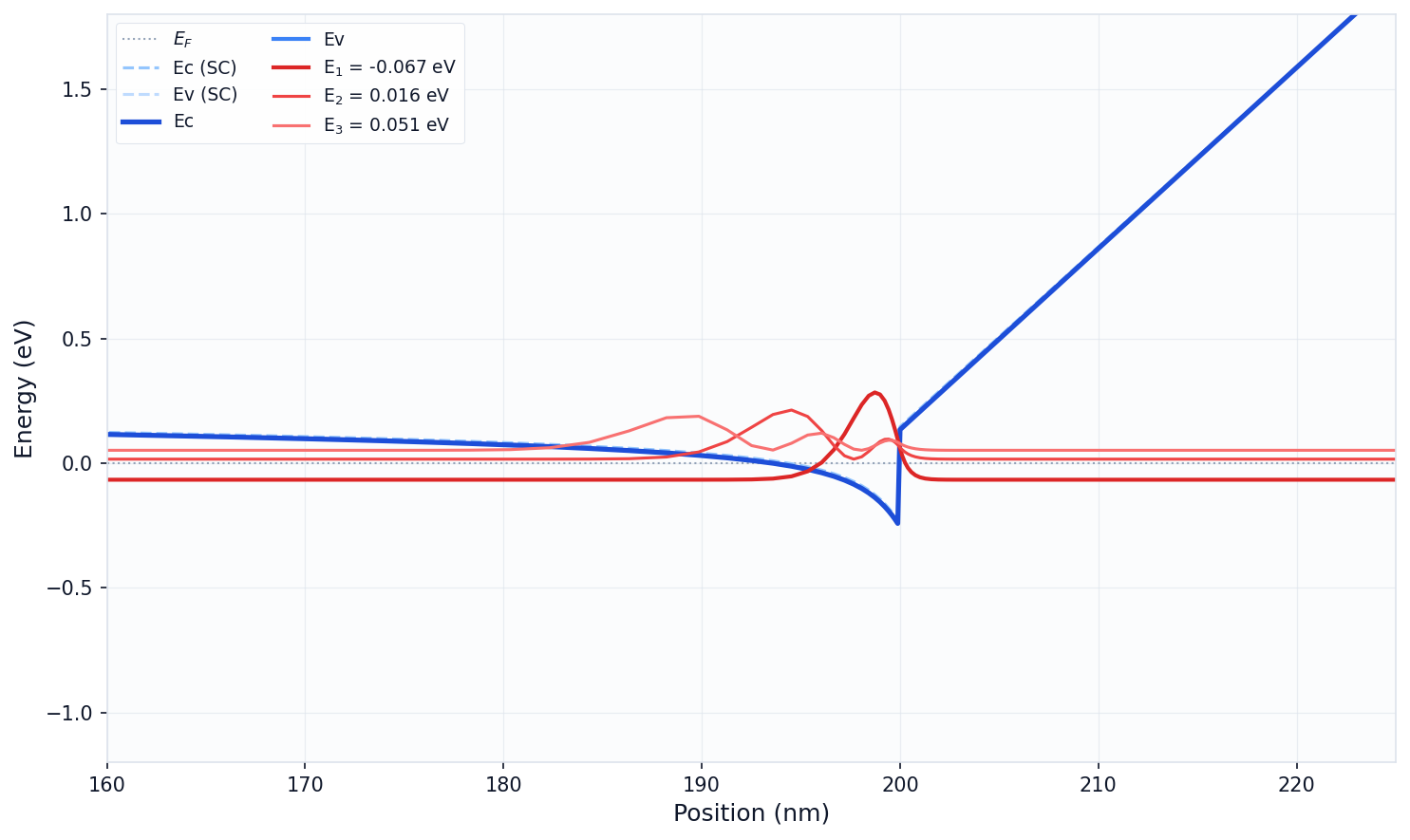
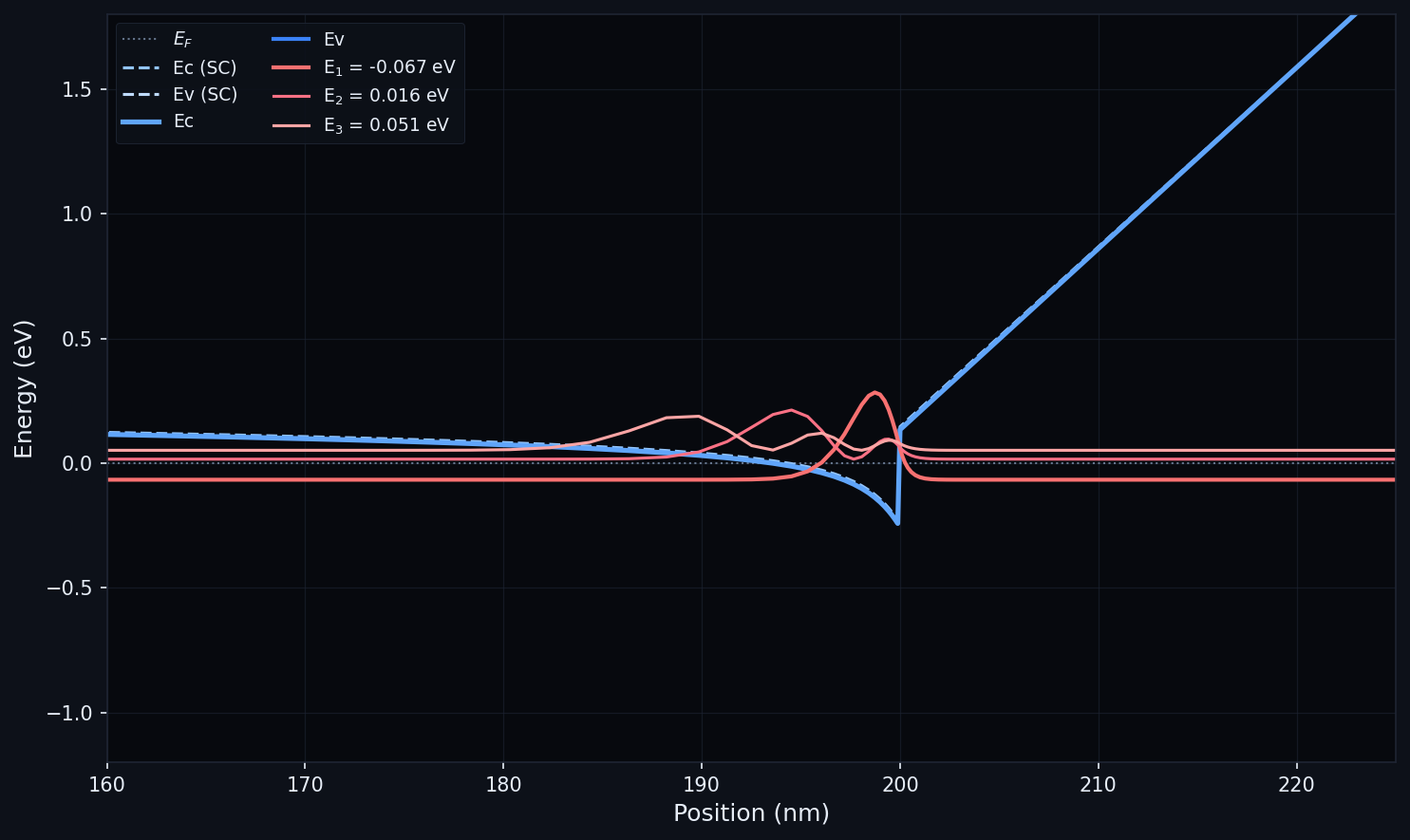
1D Band Diagram Calculation (Schrödinger-Poisson) CompletedPolarized heterostructures with quantum confinement via self-consistent Schrödinger-Poisson solver
1D C-V Simulation CompletedCapacitance-voltage analysis for nitride heterostructure devices
1D J-V Simulation In ProgressCurrent-voltage analysis for nitride heterostructures with polarization-aware contact models
Advanced 1D Simulations PlannedI-L characteristics, optical recombination, and beyond
Roadmap
2026 Q1
1D J-V Simulation CompleteDrift-diffusion current analysis for nitride semiconductor heterostructures
2026 Q2
Advanced Simulations & DocsI-L characteristics, optical models, API reference, example gallery
This software is developed based on public facts described in academic papers and textbooks. If it infringes upon anyone's intellectual property, please contact the developer — the relevant parts will be promptly corrected.
Contact
Get in touch
For inquiries about the project or potential collaborations, reach out via GitHub or Email.